Tuesday, May 15, 2012

Let them sell cake!

Bake sales!  Don't talk to me about bake sales!

As a parent, I try to keep up with my daughter's education. And like many parents, I have my opinions about education.

Being me, my opinions sometimes get me into trouble.

Lately, there has been an inordinate amount of media attention and opinions focused on a law that is designed combat childhood obesity , which bans, among other things, bake sales on school property during school hours.

And people are mad as hell!

Am I mad as hell? Yes, but not for the reason you think.

The problem is, I don't see any reason to be mad about this. I think we should do something to combat the constant onslaught of advertising designed and honed to the single purpose of getting junk food into our kids' mouths. So a few common sense steps along those lines sounds pretty good to me.

And really, should we be having bake sales during school hours anyway? Shouldn't the kids be, you know, in class, maybe? Save the bake sales for weekends, or during football games, or something. And if you have to sell something during school hours, there are other things to sell. Sell flowers. Sell books. With the internet, you can get your own t-shirts made in no time and sell those! It doesn't have to be a bake sale.

Don't get me wrong, I don't think bake sales are evil, and I don't think home-baked pies and cookies are necessarily junk food.

So what am I so mad about?

Maybe that my daughter's education is being funded by a BAKE SALE!

Seriously, a BAKE SALE!
Can I pay for her college this way, too?
Now PTOs and booster clubs and other school-related groups do a tremendous amount of work and their fundraising adds much to the schools, but have you ever stopped to wonder why all that fundraising is necessary?

Because our schools, the institutions charged with educating our children and preparing them for adulthood, are chronically underfunded.

And everyone's just ok with this?

Why can't we ban bake sales, and JUST GIVE THE SCHOOLS THE FREAKIN' MONEY!?

Now, maybe you don't agree with my "tax and spend" bleeding-heart liberal politics.  It's a free country.  You can complain all you want about retaking our country from the Kenyan Muslim Socialist president, I don't really mind.  If you want to be willfully ignorant, or just plain misguided, hey, go ahead.  But none of that changes that fact that our schools are being funded by BAKE SALES!

The future of this country, funded by BAKE SALES!

Now do you see why am I mad?  No?

BAKE SALES!

I guess what I'm trying to say is, if you're going to get mad, make sure you're getting mad about the right things.

Boy, am I worked up!  And all this bake sale talk has made me hungry. 

Daddy needs a cupcake.  Anyone know where there's a bake sale?

Wednesday, May 2, 2012

One of These Days, Norton!

I don’t plan my vacations around alcohol.  I really don't!  It just happens that way.

I try to plan my vacations around fun stuff my daughter might like, and what we all might have fun doing together as a family.
Yeah, it's a real place.

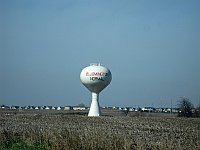
And sometimes, our vacations come about because my wife needs to travel somewhere for work, which is the only possible explanation on how I ended up in Normal, Illinois.

I’m going to refrain from making any Normal jokes.  Not that any of my jokes are ever normal.  (See? The damned things write themselves!)


Funny thing is, there's not even a
Krispy Kreme on this road.
I have to say, despite the ominous tornado warnings, Normal was a fun place to hang around.  The hotel had a swimming pool, where we spent no less than four hours each day.  And Normal also has a fantastic children’s museum, not to mention tons of nice playgrounds, a mall, Toy R Us, good restaurants, with kids menus, in short, everything a parent could possibly need.

We loved the Children’s Discovery Museum in Normal, and my daughter helped me find a geocache in the parking lot. I don't think I've blogged much about geocaching before.  I could go into it here, but better to save it for its own full entry, except to say that a couple days later, in Chicago, between deep dish pizza and baby back ribs, my daughter found a geocache all on her own. Such a proud moment.

“It’s around here somewhere.”

“Oh, Daddy, I see it! I’ll get it!”

I’ve raised her well. Even my wife was impressed. More than worth the price of visiting the two-story American Girl store.
But a beer nerd on vacation in Illinois is still a beer nerd, and some time around our second day there, I realized how close this part of Illinois is to Missouri, and realized this might be my best chance yet to get my hands on a Norton.

What, you ask, is a Norton?  Is this some kind of anti-virus joke?  Ed Norton joke?  And what does Ed Norton have to do with beer?

No, nope, and nothing.  In fact, none of this has anything to do with beer.  This is about wine, and about Thomas Jefferson’s dream for America.

I told you I was a nerd.

Thomas Jefferson, like most of the Founding Fathers, loved wine (except for John Adams, who was a hard cider man).  And Jefferson also saw agriculture as the key to this nation’s future.  One of his greatest dreams was the rise of a wine industry in America to rival that of Europe.  To that end, Jefferson, among others, sought to make wine from any of the native North American grapes that grew profusely in Virginia.

"The tree of liberty must
be refreshed, from time
to time, preferably with
a good wine."
Just one small problem: the wine was crap.  North American grapes, it turns out, while fine to eat, make terrible wine.  So Jefferson executed his Plan B.  He brought vines over from France, to create French wine on American soil.

Here, a second small problem arose: the vines all died.  Virginia, and North America in general, has a very different climate than central Europe, and that climate is all wrong for wine grapes.  And so the dream of an American wine industry died, at least during Jefferson’s lifetime.  But as we know, that is not the end of the story at all, since it turns out that parts of California are perfectly suited to growing Europe grape varieties, hence the Jefferson dream has come true.

Except, Jefferson dreamed of a uniquely American wine. 

And during the late 1800s, that dream almost came true, thanks to another Virginian named Dr. Daniel Norton.  He discovered a variety of native North American grape that made a decent wine.  Not only decent, but good enough, complex enough, to compete with European wines.

German immigrants in Missouri started growing the Norton grapes, and America’s first wine industry was born!

Unfortunately, America’s first wine industry was soon destroyed, like its beer industry, by Prohibition.  And while the post-World War II wine industry has focused on California, vintners in Missouri are still making Norton wines, and by God I was going to get my hands on one!

This turned out to be easier than I thought.  I found the largest liquor store I could find and found the local wines.  There, I quickly found bottle after bottle of Norton.  Mission accomplished!  It was off to more child-oriented activities.

Returning home, with a camera full of memories and a suitcase of wine, I tried the Norton for the first time.  I found it to be okay, while my wife thought it tasted like artificial cinnamon-covered pine cones.  I think I'll put that one in the "Not terrible" category, call it a victory and move on.  Besides, who cares how it tastes.  I have a bottle of wine that says Norton on it!  Time to find some more geocaches!


Before I finish off this entry, I would be remiss if I did not say a few words about the people of Normal.  Both my wife and I were amazed at how friendly, kind, welcoming, and genuinely nice everyone we met there was.  Compared to everyone else we met on the trip, they were anything but normal.

 (Sorry!  I can’t help myself!)

Tuesday, April 17, 2012

Lies My Beer Taught Me

“Beer is proof that God loves us and wants us to be happy.”  The famous words of Ben Franklin, seeming to grant the blessing of one of the greatest of the founding fathers, the author of Poor Richard’s Almanack, the guy who trapped electricity in a bottle, on the humble drink known as beer.

This slogan has become quite famous, appearing on t-shirts, posters, even beer glasses.  It is even being featured on merchandise at the living history museum Old Sturbridge Village.  I saw the t-shirt when my daughter and I visited there a couple weeks ago.

Just one little, inconvenient problem: Ben Franklin never said it.

Go ahead, check it out.  Find the written record of Franklin using those words.  Go on, I’ll wait.  Give up yet?  It doesn’t exist.  Franklin never said it.

But, you say, that only proves he never WROTE it.  Couldn’t he have said it in passing to someone else, who subsequently passed it one down through history?  Plausible, except for one small problem.  Franklin was a wine drinker.  And he really did use the following words to describe wine:  “Behold the rain which descends from heaven upon our vineyards; there it enters the roots of the vine, to be changed into wine; a constant proof that God loves us, and wants us to be happy.”
He also never said, "Beer is money," but we'll pretend he did.

It’s easy to see where and why the mistake occurred.  Both are nice sentiments, talking about the mysterious, almost mystical creation of alcohol.  But only one of them looks good on a t-shirt.  I can forgive that (and I have; a have a copy of the Franklin misquote hanging in my home brewery).

But what about history?  History is filled with convenient myths, like George Washington and the cherry tree.  They serve a purpose, of course, helping take the diverse episodes of history and mix them together to form a coherent stew, an easily followed narrative to teach our kids.  And so what if some of the things we learn aren’t totally true?  Does it matter?

I think it does, ultimately, but not enough to make a federal case out of it.  It matters that Franklin preferred wine to beer, but not as much as it matters that he acknowledged the importance of alcoholic beverages in life during that colonial period.  It matters that George Washington never chopped done a cherry tree and swore to tell the truth about it, but not as much as it matters that George Washington was a great leader, with the wisdom to lead by limiting his own power and inspiring those around him.  And if the cherry tree myth helps him inspire more young people even today, more than 200 years after he died, who am I to argue with that?

What matters is that our children learn about history.  I loved it when my daughter came home from a President’s Day themed lesson at school with a drawing she colored of George Washington and that damned mythical cherry tree.  I loved it, even if it never happened.  It matters (at least to me) that my daughter learns the truth about history.  But I think it matters even more that we, as parents, are encouraging them to keep learning, and that we know what they are being taught.  The myths that we learn when we’re young serve a purpose.  They help us understand the more complicated parts of our history, and help us make history relevant to the present.  And if we can help our kids with THAT, we’ll be starting them in the right direction.
But what about Old Sturbridge Village?  Can I let that venerable living history museum off the hook for featuring that historically inaccurate Franklin quote?  Tell you what, OSV, we'll call it even if you teach the kids Washington never chopped down the cherry tree.  I hate that one.

Thursday, March 22, 2012

One Down and Dirty Brew (Makin' Lambic, Pt 1)

Every homebrewer recognizes the basic commandments of homebrewing, the laws that dictate whether or not your beer will be in any way drinkable.  Ask any of us what makes good beer and the answers will rarely vary: Use only the freshest ingredients, keep your equipment clean, and sanitize, sanitize, sanitize!  These commandments were delivered by the homebrewing gods long before microbes were discovered, before the chemistry or physics of beermaking were well understood, and they will still be true no matter what innovations future generations make.

But today, I look up to the homebrew gods and tell them, “But, I’m making a lambic.”  To which they reply, after a moment of introspection, “Oh.  Well, in that case, nevermind.”

I love rulebreakers, and lambic is the brew that breaks the rules.  And makes rude gestures in the face of everyone who thinks they know what they’re talking about, too.  This is the beer in which the words “sweaty, farmyard smell” are meant to be complimentary.

Steeping some old socks,
to get the traditional flavor.
Lambic is a sour beer style originating in Belgium, closely related to the sour ales of Flanders.  It relies heavily on the wild yeasts and bacteria of that specific geographic area, meaning it is impossible to create a true lambic outside of Belgium.  But thanks to the miracle of microbiology, the predominant yeast and bacteria strains have been identified and cultured to give us homebrewers a fair chance to make our own.  It is aged for long periods and often blended, sometimes with fruit, sometimes with older and younger brews, sometimes sweetened, but all with a unique sour tang that makes it unlike any other beer out there.

So how do you make lambic?  First, you throw the rule book out of the window, say a prayer to Arnold, the patron saint of Belgian brewers, and then break out the hops!

We have to start with the hops, because the lambic style calls specifically for old, stale hops.  Where does one find old, stale hops?  In my case, I find them in my basement, six months after I opened a package of fresh hops, put them in a paper bags, and left them down there to age.  Lambics require a lot of patience.

To actually make the beer itself, I mashed together pale malt and flaked wheat, and added those old hops to the boil.  After the boil, I poured the wort into the fermenter bucket (which I did clean and sanitize, because some things are too ingrained to ignored), and let the wort sit, without adding the yeast, giving the wort time to turn sour.  Lambics require a lot of patience.
Before pitching the yeast...

...And after.  "Excuse me, sir, your fermentation is showing."

Finally, I added the yeast, which was a particular blend of cultured Belgian yeast and a bacteria called lactobacillus.  This is kind of like making bread from a sour starter (or bourbon from a sour-mash starter).  I let the yeast begin fermentation without putting the top on the fermenter.

Now, I wait for primary fermentation to finish.  And after that?  I wait some more.  This beer will sit in the secondary fermenter for at least a year.

Lambics require a LOT of patience.

In the end, I hope to make another small batch of lambic, and blend the old and new lambic together before bottling, making what is called geuze.

In the meantime, I’m feeling a little excited anxiety about the whole lambic process.  The carelessness of sanitizing, the lactobacillus bacteria, the open fermentor.  It’s all a bit much for me.  I think I need to lie down.  Excuse me.

Friday, March 16, 2012

Don't Drink the Green Beer!

Not cool, man.  Not cool.
What did that beer ever do to you?
Yes, it is St. Patrick’s Day once again, that annual celebration of all things Irish, a veritable stew of all the good things that Irish immigrants have brought to this country, like the color green, corned beef, potatoes, Riverdance, and good beer!  And to help celebrate, bars around this country will be featuring a Frankenstein creation with no cultural relevance what-so-ever: green beer.

Folks, there is nothing remotely Irish about green beer.  Now, I know that you know that it’s made with green food coloring.  But chances are, since the beer is being artificially colored and sold to guys who are already half-drunk, it’s probably a pretty cheap pale lager, barely worth your hard-earned money.  And when you consider the hundreds of years of beer brewing history around Ireland, and the fact that there is NO traditional Irish lager, green beer seems like a waste of time. 

Instead, enjoy a good Irish ale, or perhaps a stout.  Yes, Guinness, though mass-produced and now owned by Diageo, headquartered in London of all places, is still an easily obtainable example of Irish beer.  Not my favorite, but I understand why people like it. 

Red ales are also quite popular, even though the red ale style seems more connected to France than Ireland, the color come from the toasted barley, and Ireland has no shortage of that.

Just don’t drink the green beer!

Leave that to the college kids, let them enjoy the green beer-induced hangovers.  This is a time to celebrate culture over gimmicks, and quality over quantity.

I for one am making a milk stout in honor of my Irish heritage.  I think milk stout might be a little more English than Irish, but as I say, I don’t like bitter dry stouts.  The idea of a sweet stout, on the other hand, makes my mouth water.

The only real difference in style is that milk stouts add lactose, which is a sugar derived from milk (see, they don’t actually contain milk) which the yeast cannot digest, resulting in a sweeter taste.

Will my stout be ready for St. Patrick’s Day?  No chance, I haven’t even started it yet.  It won’t be ready for at least a few weeks, and even then, I’ll probably let it cellar for a couple extra weeks.  Good beer is like good wine, and gets better with age.  No, I’m planning on enjoying my Irish beer just in time for Cinco de Mayo.

This is not meant to be ironic.  Many Irish immigrants fleeing the potato famine found few job prospects in the United States, owing to Anglo-Saxon Protestant prejudice against their Catholicism.  Few options remained, one of which was an army desperate for soldiers to fight an unnecessary war against Mexico.  However, the Irish soldiers were so badly treated by their officers, many deserted and joined up with their fellow Catholics, the Mexicans.  To this day, the Irish hold a special place in the heart of Mexico, which goes a long way toward explaining why this Scotch-Irish kid from suburban Rhode Island likes spicy food so much!

So, grab an ale!  Grab a stout!  Grab a taco!

Just don’t drink the green beer!

Friday, February 24, 2012

Death to the Spice Packet!

It’s time to say goodbye to spice packets.

I was thinking about this the other night as I was making dinner, and was making a batch of rice from a box.  It came with a small packet labeled, “Spice.”  No further explanations were given.  I thought, “What is this stuff?”  And later, “Why does it taste so good?”
Packet #1138, developed in secret at Area 51.
Contents: Classified.

Which brings up an interesting point.  I tend to shy away from overly-processed foods.  I like cooking, with real ingredients, but processed food tastes so good.  If I was forced to live off one food for the rest of my life, it would probably be sushi, but Kraft Mac & Cheese is running a close second.  That stuff is awesome!  But these foods are carefully engineered to taste good, with little or no regard to nutritional value, or actual ingredients.

But not all “processed food” is necessarily bad.  After all, one of the very first processed foods is beer.  Don’t believe me?  Take grains, keep them moist until they germinate, dry and crush, then boil until the enzymes convert the starch into sugars, which the yeast turn into alcohol.  Sounds like a process to me.  Processing of foods is important and necessary.  What’s the difference between this and what I’m calling “processed foods?”  The conversion of grains into beer makes the grains easier to consume and actually adds nutritional value from the yeast and hops.  Modern processed foods make the food easier to prepare and consume, but sacrifice nutritional value and create a psychological separation between the original food and the boxed food with its spice packets.

Less than 2% of...what?!
What’s in beer?  Malted grains, hops, yeast, water.  What’s in Suddenly Salad?  Beats the hell out of me.

Just because the picture on the box looks like food, doesn’t mean it is food.  If it was food, it would use spices, not an anonymous, unlabeled spice packet.  And it would not include "Natural and Artificial Flavor" as an ingredient.  Ain't nothing natural about that.

Still, the spice packet mocks me.  It knows that as long as it remains unlabeled, I’ll never know exactly what’s inside.  And it knows that if I knew what was inside, I wouldn’t need it anymore.  We’re locked in a kind of spice cold war.  But fortunately, my spicy CIA has a few spice spies behind enemy spice lines, and I have a pretty good idea of what I’ll find in that spice packet.

-          Monosodium Glutamate

-          Artificial colors (Yellow Dye #5)

-          Chemically engineered flavors, because the real spices don’t taste “spice-y” enough.

-          And maybe some actual spice.

Is there anything wrong with this?  Isn't it the job of science to make things better for us, or give us some advantage that nature cannot?  Okay, I'm not here to argue with science, but what advantage does the spice packet give us?

In gives us more chemicals in our diet, on the one hand, and on the other, what?  Time, you say?  Certainly, time is valuable, especially to us parents.  Do spice packets make cooking faster and easier?  Well, let’s see.

First, I’ll use the spice packet.  I got my water boiling, add my rice, and now the spice packet.  I try opening one corner, but these things are built to last.  I try another corner, no luck there.  I start rummaging through kitchen drawers looking for a pair of scissors, and finally, failing in that, grab a butcher knife and chop the damn thing in half.  Spices go in.  Elapsed time: about 2 minutes.
Now, without the spice packet.  I boil the water, or, depending on the recipe, some chicken broth (hey, liquid is liquid, boiling in boiling, no time difference so far), and add the rice.  Then, I add some garlic powder, parsley, paprika, cumin, salt and pepper, maybe some cayenne if I’m in a spicy mood.  Elapsed time: about 2 minutes.
Spices.  That thing in the background is called a spice rack.
You probably have one.  Why not go introduce yourself?
What do you get out of spice packets that you don’t get out of spice jars?  MSG.  (Unless, of course, you go to a decent spice store and buy a jar of MSG, in which case, you’re golden!)  Yellow #5 (actually a synthetic chemical called tartrazine).  Something called disodium inosinate (no idea).

What do you get out of spice jar that you don’t get out of a spice packet?  Lots.  You get to know what’s in your food, you get to know the difference in taste that specific spices make, and, most of all, you get a recipe.  So the next time someone says, “I love this rice!  What’s in it?” you have an answer that doesn’t involve the word, “packet.”

I’ve been pretty hard on the lowly spice packet, and that’s not entirely fair.  Most of what I’ve said here can be applied to other processed (“boxed”) foods as well.  Processed foods are a wonderful technological achievement and they have a place in our diet.  (As I said, I LOVE my Kraft Mac & Cheese.)  But I maintain that any average person, with average cooking ability, in an average kitchen, can recreate almost any processed food from scratch without much difficulty.  It might mean some investment in time, and you might mess up the first couple of times, but in the end, you will learn the trick of it and the result will be better than any boxed or jarred food you can buy anywhere.

Friday, February 17, 2012

Dad Lite, and the Homebrew Dad

Father's Day is fast approaching, which means it's time to say a few words to all the dads out there reading this blog.  (Sorry, moms, this one is for the guys.)

Ok, dads, grab a beer and have a seat.  We need to talk.
I never stand between a father and his beer
I want to talk about parenthood, about being a dad.  And about the inherent sexism our society applies to parenting.
No, not the kind of sexism that says a woman’s place is in the home and it’s up to the man to go to work and bring home the bacon (figuratively, of course; shopping is women’s work).  I like to think that our society has moved at least a comfortable distance away from that stereotype.  (And if you happen to agree with that stereotype, I’d like you to go stick your head in a 5 gallon fermenter until you come to your senses.)  Instead, I’d like to talk about the “dad” stereotype, one that tries to dictate what we dads can and cannot do when it comes to childrearing.
I’m reminded of my place as a father in our society nearly every day.  Mommy And Me classes.  Parenting magazines geared exclusively toward mothers.  TV sitcoms featuring clueless, uninvolved fathers dispensing bad advice, with hilarity to follow.  Or, even better, sitcoms now showing dads changing diapers and driving minivans, and suddenly questioning their masculinity and overcompensating, with hilarity to follow.
And how many story-times have I been to where the teacher/librarian/person reading the story says, “And now give your moms a big hug,” glances me way, and quickly adds, “and dads, too”?

Not to mention, just a couple weeks ago, I brought my daughter to pre-school after helping her complete a project to show off, and the teacher said to me, "And tell Mommy she did a great job, too!"  I tried to take that as a compliment, but somehow, I couldn't.
Is it fair for dads, in this day and age, to be relegated to some second-class parent designation behind mothers, grandmothers, or even pre-school teachers? 

Should we be seen as an inferior, uninvolved, unwilling partner in the parenting process?  With everyone thinking of us as “...and dads, too?”

Do dads deserve this?
In a word, Yes. 
Face it guys, we have no one to blame here but ourselves.
When I first became a father, this stuff really got to me.  I would rant and rave about how fathers are not inferior, that fathers are capable of looking after children, how they are involved in their children’s lives, and how society just hasn’t caught up with the reality of the New Dad, yet.
Then, something happened.  I start meeting other fathers.  And that’s when I realized all those stereotypes are pretty much dead on.
(I’m not talking about you guys.  You guys are awesome.  Seriously, you’re reading a blog about fatherhood and homebrewing.  That right there gives you at least two points above the average American male.  No, I’m talking about the guys you see in the playgrounds on weekends, pecking away on their iphones, ignoring their kids, who are usually doing something incredibly dangerous on the monkey bars.)
It’s not their fault, those other dads.  They were raised to think men worked and women stayed home, boys don’t cry, winning is all that matters.  They turned into dads with a false understanding of what fatherhood means, and they’ve internalized all of the social stereotypes surrounding dads.  And if they do make a move in that direction, suddenly the masculinity thing kicks in and they have to go drive sports cars and go to Hooters (good wings, or so I've been told).  So we have the Modern Dad, call him Dad Lite, keeping a safe distance from any kind of real parental responsibility. 
And here I am, the Homebrew Dad, here to change all that. 

But I can’t do it alone.
We, the Homebrew Dads, must show the rest of the Dad Lites that we are not inherently second-class parents.  And that we must accept responsibility for all parenting entails, be it feeding, diaper changing, bathing, dressing, or educating, and encourage our fellow fathers to do the same.

We need to remind the Dad Lites of the world that, as dads who like grilling, who eat bacon and barbeque like their on the endangered species list, and who make our own beer, that there is nothing more masculine than being a dad.
Of course, that’s the easy half.  We dads are finally acting like parents, but we also need to be treated like parents by wider society.  And that’s the hard part, the part that I’m hoping to enlist your help with.  I’m hoping that one will follow the other: as more dads become involved parents, it will become less an anomaly and more of an expectation. It’s starting to happen. 

I know you all are out there. 

I know you don’t think it’s weird to take your daughter to Princesses on Ice.  

I know you play dress-up, and sometimes you get to be the prince, and other times, you're the Evil Queen. 

But I have a feeling, based on my own experience, that we still in the minority, and society will need a gentle shove in the right direction.  Here’s what you can do:
1.       Be a parent.  And not a Dad Lite, I'm talking about a Homebrew Dad.  Put down the iphone and pick up “Goodnight Moon.”   Stop changing channels, and start changing diapers.  You get the idea.
2.       Hang out with moms, and get used to it.  You don't actually need to have a couple recipes to swap, but I'd be lying if I said it didn't help.  I can give you a killer beer bread recipe to start with. 
3.       Show affection in public.
4.       Whenever possible, correct common misconceptions about dads. No need to be mean or snarky or sarcastic about it, just politely let people know that you are proud to be a parent.  And remember, the common misconception isn’t actually a misconception, yet, so their snarky comment about how “Your daughter’s outfit is so cute.  Did you wife pick it out?” is socially acceptable.  Don’t start any fights over it.
5.       Have fun.  Play with your child(ren).  And let them lead.  It’s kind of like improve theater.  Sometimes when I play with my daughter, my character changes seven times in ten minutes.  Just go with it.  And smile.  This is the best part.
Now you may be thinking to yourself, jeez, this sounds like a lot of work.  Can’t I just do what society expects and sit on my butt watching sports and maybe play a little xbox?  Seriously, what’s in it for me?
Hey, man, that’s your call.  But a couple of nights ago, after I tucked her into bed and kissed her goodnight and was just about to turn off the light, my daughter shouted, “Wait!”  And she jumped out of bed, ran over to me, threw her arms around my legs (what can I say, she’s short), and said, “I love you, Daddy.”
And that’s reward enough for me.
“Daddy, can I sleep in your bed, tonight?”
Not a chance.